Rise of the Sicilian bourgeoisie
The LeopardThe Rise of the Sicilian bourgeoisie is a gradual transfer of wealth and political influence, not a clean replacement of one ruling class by another. In the world of the novel, liberal change gives ambitious local men new opportunities, while marriage, patronage, and inherited prestige allow them to enter established circles. Don Fabrizio Corbera, Prince of Salina, recognizes the shift early: what threatens the aristocracy is not necessarily its destruction, but the arrival of successors who can occupy its places and preserve much of its social order.
New Wealth and Local Influence
In Palermo, Don Fabrizio Corbera hears the change emerging in the language of his dependants. Don Ciccio Ferrara, the accountant, anticipates political upheaval and speaks hopefully of a prosperous future, but Don Fabrizio Corbera distrusts both his confidence and the promise that political change will deliver general improvement. He sees Ferrara as representative of the class gaining power, and expects that the transformation will bring little fundamental change to Sicily. Don Pietro Russo, another dependant, makes the new order more concrete: he supports the young men’s cause, complains of restrictions and surveillance, and predicts greater liberty, lighter taxes, and expanded trade. Yet he also insists that the old families will remain protected. His political hopes coexist with private calculation: he is trying through intermediaries to buy Argivocale, and had previously concealed the Prince’s lemons in his cellar.
Don Pietro Russo’s mixture of loyalty, self-interest, and reassurance exposes the practical means by which influence changes hands. He presents himself as a dependent who regards Don Fabrizio Corbera as a father, while pursuing his own property interests and relying on friends who may protect Villa Salina. Don Fabrizio Corbera understands that such assurances do not promise the old aristocracy continued command. They promise its members safety and a place in the emerging arrangement, while others acquire the advantages formerly associated with them. His image of the swallows leaving the nest a little earlier captures a transfer that is real but measured: the established order is disturbed without being wholly overturned.
Don Calogero Sedàra’s Rise
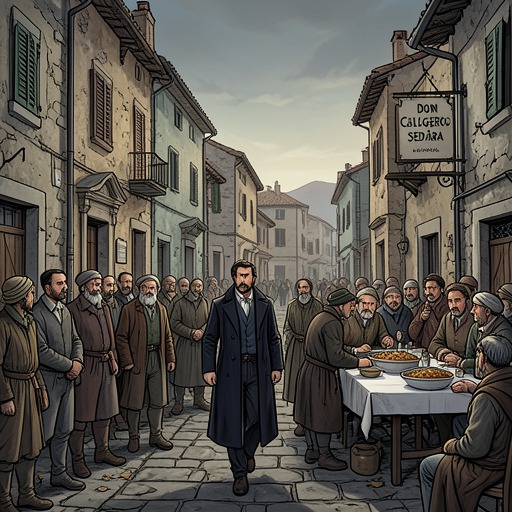
The change is especially visible in Donnafugata. Don Onofrio Rotolo reports that Don Calogero Sedàra has converted a loan of one thousand ounces of gold into possession of an estate yielding five hundred ounces a year after a mortgage fell due. Sedàra has also bought land containing a valuable stone vein and made profitable grain sales during the confusion and famine following the landings. Don Onofrio Rotolo estimates that Sedàra’s income will soon equal Don Fabrizio Corbera’s income there. Wealth has brought political influence as well: Sedàra leads the liberals in the town and surrounding districts, and is expected to be elected as a deputy to Turin. His rise is therefore not merely a matter of private fortune; property and political authority reinforce one another.
The plebiscite gives that authority a public, ceremonial form, but the reported result also reveals how managed the political transition is. Don Fabrizio Corbera votes yes and hands his ballot to Don Calogero Sedàra, who presides over the local proceedings. At the announcement, the official count is 515 voters, 512 votes cast, 512 yes votes, and no votes recorded against. The ceremony joins the new national symbols to the local power of Sedàra, while the unanimity of the published result leaves little room for political opposition to appear. The episode presents bourgeois ascendancy not as an abstract program alone, but as local administration, control of public ritual, and the ability to define the visible outcome.
Marriage as an Exchange of Resources and Status
The marriage of Tancredi Falconeri and Angelica Sedàra brings the two classes together in a particularly direct form. Don Fabrizio Corbera praises Tancredi’s social intelligence, ambition, and understanding of people, describing him as a man capable of advancing in the new era. Don Calogero Sedàra responds by setting out what Angelica will bring to the marriage: the Settesoli estate, 644 salmi or 1,010 hectares of farmland, olive groves and vineyards at Gibildolce, and twenty linen sacks containing 10,000 ounces of gold each for the bridegroom. The figures make the scale of the alliance unmistakable. Sedàra’s fortune supplies land and capital; Tancredi contributes aristocratic standing, political instinct, and entry into the old social world.
For Don Fabrizio Corbera, the arrangement brings both attraction and unease. He is disturbed by the blunt financial terms, yet the beauty of Angelica and the grace of Tancredi soften his response. Don Calogero Sedàra, meanwhile, speaks of his daughter affectionately while making her inheritance explicit. The marriage thus does not erase the distinction between old nobility and new wealth; it turns that distinction into a resource on both sides. Sedàra gains a connection to aristocratic identity, while Tancredi gains the funds and property that support his prospects.
Political Incorporation and Continuity
The alliance continues after the wedding. Don Calogero Sedàra finances extensive restoration at Villa Falconeri, which Don Fabrizio Corbera oversees. Plush furnishings and Minton figurines appear within the building’s older proportions, while the new investment helps remove the threat posed by legatees and bailiffs. The setting makes the social transaction visible: new money repairs and inhabits an aristocratic property without eliminating its inherited architectural character.
Tancredi’s political career also shows how the new order absorbs rather than rejects established forms of influence. Although still too young for a particular government office, he becomes indispensable through his energy and fresh funds. He works in the politically advantageous space described as the extreme left of the extreme right, concealing intense activity beneath an appearance of nonchalance. The combination of money, inherited connections, and adaptability gives him room to maneuver across political positions.
Don Fabrizio Corbera’s recommendation of Don Calogero Sedàra for the Senate makes the transfer explicit. Refusing the role for himself, he argues that Sedàra has practical ability, power, and fewer illusions about politics, and notes that Sedàra’s conduct during the May crisis was useful. He also warns that Sedàra may seek election to the Chamber of Deputies. A decade later, Sedàra does enter the Senate. Don Fabrizio Corbera’s recommendation therefore anticipates a result in which the bourgeois newcomer occupies a national institution that the aristocrat declines.
A Changed Order That Preserves Its Forms
The ascent of the bourgeoisie changes who commands wealth and public office, but the novel emphasizes incorporation as much as displacement. Don Fabrizio Corbera foresees that old titles and symbols may pass into new hands, while the Salina name itself can survive through accommodation and compensation. The new class seeks property, influence, and social recognition; the aristocracy retains a role by accepting alliances and yielding positions it can no longer securely monopolize. The resulting order is altered in personnel and resources, yet continuous in its reliance on rank, family connection, and political maneuver.
This pattern gives the bourgeois rise its central tension. Sedàra’s fortunes and public authority are genuine changes, and Tancredi’s marriage and political activity make them consequential across generations. Yet the transition does not become a wholesale social renewal. New wealth enters old spaces, political advancement travels through familiar networks, and aristocratic identity remains valuable precisely because it can be joined to money. The emerging class rises not outside the old order, but through its doors—and helps keep much of that order standing.